Showing posts with label plant science. Show all posts

Sunday, August 24, 2014

Hunting and Fishing (part 1)

Some friends in the world of Cakile (sea rocket, the annual beach plant I researched for my Master's) want to know the extent of the spread of two closely related species (C. edentula and C. maritima) along the west coast of North America, including California, Oregon, and Alaska.

Sea rocket originated in the Middle East a long, long time ago, eventually migrating on the ocean currents across the Atlantic to North America. The seeds of this plant are quite remarkable. The seed is about the size of a grain of rice, encapsulated in a very buoyant, fleshy, salt water-resistant fruit that looks kind of like strings of shiny little plastic green beads arranged along a stalk. Because of this floaty quality, the seed has hitch-hiked around the world to seek its fortune as a kind of biological stowaway in the ballast water of ships. After a long ocean voyage, it loves nothing better than to germinate on the bare sand a few feet from the surf. Once established, it grows quickly into a large, sprawling weed, topped with unremarkable little purple flowers.  The non-showy flowers can be either self-pollinated or get somebody else's pollen from a visiting bee or fly. The plant puts most of its energy into developing those shiny little beads to perfection. A good half-meter sized Cakile (or "Cakilezilla" as I like to call them) can contain hundreds of fruits, and all this weight eventually results in the plant collapsing upon the sand, which is perfect, as you will see. The fruits consist of two very cleverly designed segments: the segment closest to the branch end is usually cross-pollinated, while the segment on the very tip is usually self-pollinated. Once the seeds have ripened, the fruits at the tip can detach and float away, while those on the branch end stay put on the mother plant. Alas, Cakile is an annual, so Mom always dies in the end, but her attached children--half siblings for the most part---overwinter in the sand to germinate the following spring.

Two years ago, I'd spotted a single specimen of American sea rocket (Cakile edentula) on the little beach behind Two Sisters Bakery in Homer, Alaska. I told my friends I'd try to make it down there this summer. As luck would have it this year was good timing, and Joanne, who makes her living among humans as a nurse practitioner, was game to accompany me for a couple of days of exotic plant sleuthing.

I honestly didn't think we'd find any.  I'd decided on Homer Spit, a 4.5 mile stretch of sand that sticks out from the southern end of the Kenai Peninsula like a long, skinny finger into Kachemak Bay.  I chose a half-mile transect along the beach beginning at the RV park near the tip heading west toward the bright red wooden barn housing Lucky Pierre Charters. From my past experience, sea-rocket is usually found among people and their boats, and as we started out, we found lots of things that resembled sea-rocket: sea purselane (Honckenya peploides), seabeach groundsel (Senecio pseudoarnica), seashore saltbush (Atriplex drymarioides), and oysterleaf (Mertensia maritima) among others. Then Joanne called me over: she'd spotted it: Cakile edentula. The good folks of the West Coast Cakile Project had provided a great visual guide of both species that we'd printed for reference, and Joanne, who has no botanical training outside of gardening, was a natural. Once we saw the first one, we found others rather few and far between. We came to the end of the transect with just 24 plants, and then in the shade of Lucky Pierre's we found more than three times that many: some were tiny little things with one or two fruits, most were medium-sized, and some were big honking Cakilezillas loaded with beads.  Although European sea rocket (Cakile maritima) has been documented in Alaska, we did not find a single one in our beach walk.

But this was just Part One of our excellent adventure...

our sampling map

Homer Spit looking East toward Seldovia

Sea rocket growing among rocks by the sea

C. edentula fruits resemble shiny green beads


me with a Cakilezilla


Friday, June 1, 2012

May, I mean June


Hmmm, haven't posted anything in a while. I've been Really BUSY! I've peered into four hundred little green gardens. That have now turned into mold/fungus gnat gardens. I'm trying to count ungerminated seeds by looking at pinches of dirt under a microscope. It's a bit like flying over a plane crash. Bits of black, twisted stuff everywhere, not much is recognizable, there's no life.

For a contrast there's the seedlings which are growing nicely.

Well Joe just called, he's back from Toolik so I gotta run!!


Sunday, March 25, 2012

March Madness!

We hit the ground running after we got back from our trip to Santa Fe/Chicago.

I had signed up for greenhouse space at the UAF greenhouses to begin my germination experiment.

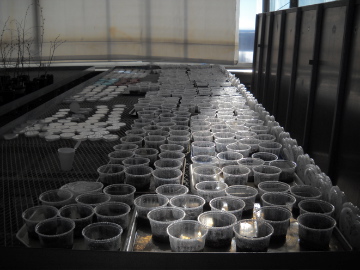
The 70 or so samples I collected last summer were washed into sieves to capture the seeds and exclude rocks and roots, and then poured into 400 little plastic pots all lined up like soldiers whose mission is to test the seedbank (seeds in the soil) of native tundra that has experienced two types of climate-change linked disturbance: wildfire, and ground subsidence caused by melting permafrost (known as thermokarst).


I figure there's a chance the disturbed areas could favor seedling germination compared to intact tundra, which is just so crowded with plants all jockeying under the midnight sun to suck up what nutrients they can. The tundra of the Low Arctic is considered a type of green desert--think of the moors of Wuthering Heights--yet during that brief summer it does a tremendous job storing carbon as the plants capture CO2 from the atmosphere and turn it into roots and shoots. Then the long cold winter sets in, and what has died stays frozen for a long time, accumulating layer after layer like a really disgusting version of a Baskin Robbins ice cream cake made of the partially decomposed remains of carbon-based life. A changing climate can potentially transform this cake into an oozing mess, whose seething surface will then spew all that CO2, along with gobs of stinky methane, into the atmosphere. But life has a way of trying to persist, and along the way, any number of things can happen. One of the things I'm interested to know is if some of this melting is just enough to favor the germination of certain types of seedlings. Why should this make any sense at all, in a world of hotter summers, longer autumns, brutal winters, and earlier springs characterized by stormy weather? One of the things noticed in the last 50 years is that the tundra is beginning to resemble something less like a golf course and more like a vast thicket of bushes. So how come the bushes are winning? The current wisdom focuses on the story of increased nutrients released by the warming soils as the hungry microbes process more and more nutrients all snug and insulated under thicker blankets of snow. This could be very good for the bushes, especially the ones that have made it this far. More bushes trap more snow, which could make the microbes happy to release yet more nutrients--to feed yet more bushes. That's where I come in with my brilliant idea (said rather dryly): the tundra is like a green mat, and the scars formed by the ground subsidence and the fires can act as openings in the mat to let new generations germinate in that warmer, richer environment. And if the babies don't make it, perhaps the bushes just push into those warmer richer pockets and clone their way across the tundra.

That's the hypothesis anyway. Not only will I be testing for babies, I also have a plan for screening for the rise of the clones.

So, without knowing whether I'd be accepted to the PhD program at UAF or not, I plunged into my seedbank germination experiment, committed to watering and surveying the contents of these 400 pots for the next nine weeks. I have seeds from remote parts of Alaska's North Slope that have experienced some dramatic disturbances in recent times: the huge Anaktuvuk River Fire of 2007, and a few lakes near Toolik whose shores have gullied and eroded through the melting of the subsurface ice. What's important is that I need to compare the seedbanks of these disturbed sites to nearby undisturbed tundra, and though I have seeds from a couple of areas in Anaktuvuk that did not burn, I need to sample a couple more undisturbed sites close to the thermokarsted lake shores in order to really be able to test the idea that disturbance favors the bold (seedling, in this case).

(cute lil' seedlings found in pieces of tundra recovering from the Anaktuvuk River Fire during the 2011 vegetation "pluck")


Long story short, I've been acting like I'm already in the program. And then I got my letter of acceptance.

I got in.

I got IN! I'm starting in September.

Me—a PhD student? Is the Universe cool or what? People have begun to call me “Doctor Dee.”

I guess this means I have to walk the walk now. But for now, I'm watering my pots, and have spent the last two weekends working my butt off preparing these pots (with the generous help of my dear husband and our next-door neighbor Helene), followed by a weekend of nonstop partying with Simon, Chris, and their friends and dog mushing clients. I met a really cool Kiwi couple on holiday who fell in love with the Alaska mushing scene and invited Joe and me to come visit them, and two really cool Norwegian gals who are heading to the White Mountains for a six day trip.

(went to ice alaska on friday)


Last night it was square dancing in Ester, followed by beers at the Golden Eagle until 2:30 am. I don't know where all this energy has come from. But I definitely feel things have shifted. For awhile I was feeling like I would never find anything beyond the job at the lab, which pays the bills and is a good learning experience but was not something I intended to do forever. And just as the routine was beginning to get to me, my application came through. So things will be different. I will continue in the lab doing much the same as I do now, but my position will be as an RA and not as staff. The rest of my time will be my own, for doing my work, writing grants, attending classes, etc etc. It reminds me of what it was to be an art student, but with more structure, without sacrificing creativity. I just hope I can find out something cool about tundra seedling recruitment in this changing world, and I hope at the end of it I can say I was happy to be a flea standing on the scientific shoulders of the giants.

As if to illustrate this last point there is a fungus gnat in the living room trying to fly up my nose....

Saturday, August 6, 2011

Toolik redux

Toolik is the kernel of Joe's and my Alaskan experience. It is the reason we came to Alaska in the first place. I first lived here in the summer of 2009 as Donie's research assistant. The following summer, Joe experienced his first Toolik summer hired on as a Field Operations Assistant/camp bike mechanic while I stayed in Fairbanks working in the lab on Donie's snowfence-isotope project. Now the end of this summer has brought us together, along with Mark, for Donie's Anaktuvuk River Fire "pluck"--an army of students, scientists and volunteers converged in Toolik's Lab 2 to disassemble chunks of tundra into discrete plant pieces in order to understand the tundra's productivity 4 years after the fire.

I return to Fairbanks tomorrow, and these past 17 days have been intense, often challenging, and also very grounding. While here I've re-acquainted myself with lots of folks and met some very cool people. I've also been working on an idea for a study of my own that should complement Donie's work on plant community changes/shrub expansion in the tundra under climate change--I've begun collecting soil samples that I will germinate in the spring to understand how fires and thermokarsts affect the seed bank of such large disturbed areas, and thus how these disturbances might affect genetic diversity of plant communities.

Joe fills up at Toolik

Chez Shibinex, our cozy quarters for the next several days

Mark in the middle of the pluck

Kyoko takes leaf area index measurements

Flying to the burn

Donie and Peter with pilot Matt at the burn

Four years later the burn's effects are still evident--these cottongrass tussocks survived the fire but died subsequently

We measure the productivity of vegetation using a variety of different methods: percent cover, foliage reflectivity, and leaf area

Cloudberry is abundant at the burn site

The famous Blacklight Party

Laura shows Kyoko how to measure the reflectivity of an orange

The girls enjoy a well earned hike in the Brooks Range

On Sheep Mountain looking North, Colin can see his site at Imnavait Creek


Claire leads the way down just before it rained

Gus and crew comparing "samples"

Dr. Ray shows us a tiny white spruce tree, a survivor of tussock transplant experiment 32 years ago--the only spruce tree known to survive this far north!

Christian flies us to our destination in style

Camilo and Kira harvest a soil sample at the burn

The thermokarst at NE-14, a lake just north of Toolik, was discovered just a few years ago. The permafrost underneath is still actively melting and collapsing the soil and vegetation down the slope into the lake, while some species, like this fireweed, seem to benefit from the disturbance.

Lakes I-2 (in middle of photo) and I-1 (larger lake behind it) have both mature and active thermokarsts on their south banks. I-2 has a more active one at its inlet a little further east

My first transect at Lake I-2 where I collected seedbank samples

I-1 way in the distance. Will I ever get there before I leave?

Thursday, September 9, 2010

Trip to Kenai Peninsula


Alpine Meadow on Harding Ice Field trail

This past Labor Day weekend I was lucky to be asked by my friend Lisa, a graduate student at UAF, to help her on a collecting trip to Seward, Alaska on the Kenai Peninsula (about 500 miles south of Fairbanks). Lisa's destination was Kenai Fjords National Park where she's studying plant populations. To get to these populations we had to hike up the Harding Ice Field Trail, about 3.7 miles of mostly steep upward climbing, through rainforest (yes it's a rainforest!), lush alpine meadows still abloom with lupine and other lovely wildflowers, up further still over scree fields covered with patches of snow threaded with a few small fast flowing creeks, 1/4 mile before the trail's end, overlooking a spectacular view of Exit Glacier.

Lisa, brilliant future scientist that she is, received a research scholarship that covered the cost of our trip--meals, lodging, and gas for Kaneesha--so it was an all expenses paid holiday for me! I basically drove, kept her company, and took a few soil temperature measurements. Most research trips should be this easy!

On our way down she spotted the white round heads of belugas passing through Turnagain Arm, and we stopped to admire them in the wind and rain.

After collecting work was done Sunday afternoon we saw the Sea Life Center and had a nice early dinner at one of several nice restaurants. I highly recommend a trip to Seward--it's a small town with great seafood in a beautiful part of Alaska!


Me on the trail overlooking Exit Glacier


Exit Glacier


Ranger Brooke guided us to the plants and made sure we complied with NPS rules


Black bear mom and cub grazing peacefully at a distance--bears here are accustomed to seeing humans but NOT habituated to humans as bringers of food, an important distinction and an ongoing challenge for the rangers to educate the public


this marmot was really close to the trail


Portage Lake has a visitor center and they give boat tours of the calving glaciers