Friday, August 24, 2012

Our 4th Autumn


Summer sure went fast.  Faster than Simon's antiquated yellow truck.


Faster than whatever Joe just saw

Faster than Simon was able to start the truck


So fast I was only able to grow micro-vegetables


And we only had one afternoon to pick 20 lbs of mushrooms


but woo hoo! a dozen wok loads for the freezer


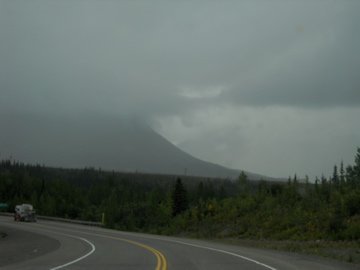
Joe and I had just one weekend for a getaway south past Denali

 past Turnagain Arm
 to Seward and Homer


so fast that by the time we got home again the leaves were turning


and the skies are getting dark


 and you can't just pretend fall isn't happening when fireweed looks like this on the way to the outhouse


We'd driven through every kind of weather and saw full on summer down in Homer


only to come back to ripe fall in Fairbanks


a neighbor gave us these nice tomato plants just before the frost 


Winter is around the corner.
But we have wood. And skis, and sweaters. And wine. And lots to celebrate.

Monday, July 30, 2012

So look!


Midnight sun, Toolik Lake, Alaska.  Photo by Diane Walsh
...see the sights
The endless summer nights
And go play the game that you learnt
From the morning


Monday, July 9, 2012

Why I couldn't sleep

On Sunday afternoon around 4 PM I was upstairs looking for something when I heard a loud bang, and realized that a bird had hit the window. Gingerly I opened the balcony door a crack, in case I was met with a disoriented bird trying to dart inside. Instead I saw a young robin on its back, its feet up in the classic pose of death. As I opened the door it turned its head towards me and opened its beak wide, once, then again, but no sound came out, and after flexing its body it lay still. I closed the door softly, hoping it would right itself and recover, as I've seen many birds do, and after a few moments I opened the door again. This time it didn't move, but I put on leather gloves and got a clean plastic waste paper basket, figuring that an unconscious bird waking up inside a container it would remain calmer during the short trip down the stairs and out the front door to freedom. I stood over it, talking to it, half expecting a sudden burst of movement, but it moved not a muscle. Gently I picked it up by the feet and slid my other gloved hand under its body.


I have disposed of dead birds before, but always much after the fact, quickly flinging the dried up little things into the bushes. This bird was surprisingly heavy, and limp like a rag doll, its little head slumping to the side as I placed it in the container. After bringing it out the front door I took it in both hands and went down the path that leads to a little duck pond. It was still warm and showed no outward sign of injury, its yam colored breast marked with juvenile speckles. Not a dried up little thing at all but a creature that had been throbbing with life just a few short minutes ago.  I chose a spot under some bushes and laid it in a little depression on the ground. Its body draped limply in the depression, as if the little birdie was fast asleep, except that sleeping birds don't lie comatose on the ground.  I said goodbye and walked back to the house.

It bothered me for the rest of the day.  The heave of its body I now realize was the moment of death. I have never watched a person or an animal die, but I will never forget the way it opened its beak, as if to say: it hurts! It hurts!

Later on the balcony I examined the window and found the tiniest smudge of gray down stuck to the glass. The window was caked with dust, and around the smudge I took my finger and drew an outline of a hawk, not because I thought it would help but because I felt it was my fault that the poor bird flew into the window. If I had put a hawk sticker on the window this would never have happened, and I would not be remembering so vividly a bird experiencing its final moments in unmistakeable pain and surprise and terror.

This morning, rather than stew over how many more bodies would be waiting for me this evening, I got out the windex and paints and brushes, and did three windows before leaving for work.


Wednesday, July 4, 2012

Midsummer


Climate change is on a lot of people's minds these days. It's one of the hottest summers on record--upper 90's in the midwest and atlantic states, and dry as a bone from the west coast to the heartland. In Fairbanks this July it has been relatively dry and warm compared with a rainy May and June, with temps in the mid to upper 70's. Two weeks ago during the longest days of summer we had a week in the mid to upper 80's, the week of Matt and Stephanie's visit. And not just hot but humid too. The previous two summers were warm early and cool and wet by midsummer. Hot and humid is not what I've come to expect up here.

Joe and I have only been here three summers. The climate change skeptics (as opposed to the deniers, who don't look at the science at all but simply deny the existence of anything that would mean no more drive-through Starbucks) cite 'inter-annual variation' as a reasonable contradiction to the idea that the planet is warming, because inter-annual variation--patterns of hot or cold, wet or dry, stormy or calm weather that may characterize a season as 'unseasonal'--throws a certain amount of noise into the records, and thus the predictions.

Climate skepticism is fine, but it doesn't explain drastic things, like disappearing glaciers, shrinking sea ice, and gullies and cracks opening up in ground riddled with permafrost—it's a bit like those rich people aboard the Titanic who felt nothing more than a bump that sloshed the brandy in their snifters, so they went back to their card game. This is why animal lovers are freaking out about polar bears, people who live in the North are getting nervous, and the entities who brought you Exxon Valdez, Prudhoe Bay, and Halliburton are casting their evil eyes upon the Arctic coast and tenting their fingers like Mr. Burns. The sea ice is melting faster and forming later, the oil companies and their political cronies stand to make billions out of it, and polar bears, fisherman, and coastal Native communities are being forced to get to the back of the economic bus.

As I consider what to study up here and how to study it, and to understand its relative importance against the larger ecological and sociopolitical background, I wonder how long before the world as we know it--the world with its budding springs, lazy summers, and cold, stable winters--becomes a very different, and very harsh place to live? Many ecosystems have been wrecked at our hands, over and over. It starts with the wild things that are tasty to humans and progresses to things most sensitive to disruption, things that live in water or are rare and dependent upon specialized habitat--orchids, amphibians, birds, insects. We don't perceive these changes until the link directly impacting human survival is affected, and by then the damage has magnified like a huge wave looming into view. How long before the standard of living we so heedlessly enjoy is swept away? Two generations? One? Half a generation? When will people stop driving gasoline-powered engines? Until the oil runs out, or before then? How long is that?

I really want to know. Because it's not just about orchids and frogs now, or even weather.

At 52, I've had a pretty good run, but it will be a very different world twenty years from now, if I live to see it. If I die of old age before that, that's perhaps luckiest of all. There is no sense in pretending we will ever be able to engineer our way out of this predicament. Humanity has gone global for better or worse. There is a last-ditch plan being worked on as we speak by “climate engineers,” a way of spewing enough aerosol particles into the atmosphere to reflect sunlight away from earth and cool it down a bit (cool it down?! How god-awful and Doctor Strangelovian!). And where did such a 1950's sci-fi horror flick of an idea come from? I think scientists have been tinkering with this idea for the past couple of centuries, but current research was inspired by Mt. Pinatubo. Its eruption in 1991 was just cataclysmic enough to reduce sunlight hitting the earth by ten percent—but not to extinguish life. Thus inspired, these geniuses still need to: A) find a suitable type of material in an amount that won't poison us too much or wreck the biosphere (sulfur dioxide is a serious candidate); and B) figure out how to get it up there. I'd be curious to know if the first powerpoint lecture on this was shown at TED.

Unlike the rest of the country, our summer in the Alaskan interior has been lovely, and I am trying to soak up every minute. The hills are clad in bright green birch and poplar, the fields and meadows are glowing fuschia with fireweed, the air is fragrant with flowers and alive with winged creatures great and small. Will we ever remember a summer like this again?


Tour of Fairbanks, one month ago. Joe is just behind Tyson, at start line of last stage (over Wickersham Dome to Globe Creek).  Nothing like a bunch of racer boys in tights--


Went to Moose Mountain to look for morels. This was the third of five attempts to find any. Found none :-(

Solstice tree


Midsummer here has a living, dripping juicy quality. Summer is full-on summer. Hard to explain, best felt. Sorry about the mosquitoes this year, Steph and Matt!

Joe and I enjoyed some hot summer weather before he headed North to Toolik for a long summer shift. I will be joining him in a couple of weeks.


Stephanie and Matt came from Chicago to experience the Midnight Sun. Stephanie on alpine tundra on top of Murphy Dome.


Friday, June 1, 2012

May, I mean June


Hmmm, haven't posted anything in a while. I've been Really BUSY! I've peered into four hundred little green gardens. That have now turned into mold/fungus gnat gardens. I'm trying to count ungerminated seeds by looking at pinches of dirt under a microscope. It's a bit like flying over a plane crash. Bits of black, twisted stuff everywhere, not much is recognizable, there's no life.

For a contrast there's the seedlings which are growing nicely.

Well Joe just called, he's back from Toolik so I gotta run!!


Sunday, April 8, 2012

Springtime in Alaska!

Dateline: April 8, 2012, Easter Sunday.

This morning Joe got our roadbikes off the ceiling (don't ask), tires pumped, gears ready :-)

He dropped me off at the UAF greenhouse where I will be spending the rest of my life until I die or I get my PhD, and we brought my old beat up Tomassini ("Tomas") in Kaneesha so I could ride home after getting all my work done (consisting of potting up germinants for later identification, plus an exploratory application of gibberellic acid to induce germination in 30 of 397 pots containing what I imagine to be scores and scores of lazy-ass seeds lying dormant under soil that is getting waterlogged and rotten by the day )|:o(

All that was not as fun as riding home this bright and sunny afternoon on miles of clear dry shoulder past piles and piles of old April snow on a road bike [:-)

It is about 45 today which for us is glorious! Riding home from UAF you have to go downhill, a pretty good long descent on a bike, and it's really fun except at my age I get really teary eyes from the wind, causing concern in probably a very small fraction of 1% of passing drivers (Good GOD Harold that woman is in tears, DO something!!):-O So far nobody has said or done anything to express such a far-fetched hope :-D

Anyway, TODAY was the first road ride, and I felt like I had wings! Compared to the mountain bike commute of the past six months [:-|)

I mean it's good and all--the mountain bike commute takes place on local winter trails. Whereas the road bike commute takes place on the shoulder of the road. It's about three miles longer on the road than on winter trails, but entirely worth it, because it's when you know for sure that winter is over |-D

Old sourdough Alaskans are probably used to believing that their winters last eight long months (September to May). Which probably used to be true (;-)

Nowadays it's more like October to April (six).

If you consider that the current winter's snowpack formed around about the middle of October 2011 and won't be 100% gone until probably the middle of April, that makes six.

Chicagoans are used to thinking they have six months of winter. HA! And again, HA! (|-D

It's true Chicago is very windy, I didn't realize how windy until I moved to Fairbanks. Where we live, wind is a pretty rare event. We are hundreds of miles inland from large bodies of water, so storms just don't roll in and wreak havoc in Fairbanks with the same frequency of Chicago, or even Anchorage (:O}

But what's even more wonderful, more glorious, than today's above 40 bikeride, I came home and sat with Joe on our sunny porch, around 5:00ish (sun sets at around NINE PM, dig it, yall!), and presently I heard a FLY buzz past me. A FLY!!! You know that spring is truly here when a winged insect feels sufficient warmth to become active and airborne in Alaska. Today is indeed their resurrection. >8-o

Go Flying insects!!!


HAPPY EASTER!

Sunday, March 25, 2012

March Madness!

We hit the ground running after we got back from our trip to Santa Fe/Chicago.

I had signed up for greenhouse space at the UAF greenhouses to begin my germination experiment.

The 70 or so samples I collected last summer were washed into sieves to capture the seeds and exclude rocks and roots, and then poured into 400 little plastic pots all lined up like soldiers whose mission is to test the seedbank (seeds in the soil) of native tundra that has experienced two types of climate-change linked disturbance: wildfire, and ground subsidence caused by melting permafrost (known as thermokarst).


I figure there's a chance the disturbed areas could favor seedling germination compared to intact tundra, which is just so crowded with plants all jockeying under the midnight sun to suck up what nutrients they can. The tundra of the Low Arctic is considered a type of green desert--think of the moors of Wuthering Heights--yet during that brief summer it does a tremendous job storing carbon as the plants capture CO2 from the atmosphere and turn it into roots and shoots. Then the long cold winter sets in, and what has died stays frozen for a long time, accumulating layer after layer like a really disgusting version of a Baskin Robbins ice cream cake made of the partially decomposed remains of carbon-based life. A changing climate can potentially transform this cake into an oozing mess, whose seething surface will then spew all that CO2, along with gobs of stinky methane, into the atmosphere. But life has a way of trying to persist, and along the way, any number of things can happen. One of the things I'm interested to know is if some of this melting is just enough to favor the germination of certain types of seedlings. Why should this make any sense at all, in a world of hotter summers, longer autumns, brutal winters, and earlier springs characterized by stormy weather? One of the things noticed in the last 50 years is that the tundra is beginning to resemble something less like a golf course and more like a vast thicket of bushes. So how come the bushes are winning? The current wisdom focuses on the story of increased nutrients released by the warming soils as the hungry microbes process more and more nutrients all snug and insulated under thicker blankets of snow. This could be very good for the bushes, especially the ones that have made it this far. More bushes trap more snow, which could make the microbes happy to release yet more nutrients--to feed yet more bushes. That's where I come in with my brilliant idea (said rather dryly): the tundra is like a green mat, and the scars formed by the ground subsidence and the fires can act as openings in the mat to let new generations germinate in that warmer, richer environment. And if the babies don't make it, perhaps the bushes just push into those warmer richer pockets and clone their way across the tundra.
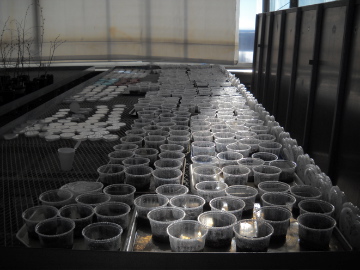
That's the hypothesis anyway. Not only will I be testing for babies, I also have a plan for screening for the rise of the clones.

So, without knowing whether I'd be accepted to the PhD program at UAF or not, I plunged into my seedbank germination experiment, committed to watering and surveying the contents of these 400 pots for the next nine weeks. I have seeds from remote parts of Alaska's North Slope that have experienced some dramatic disturbances in recent times: the huge Anaktuvuk River Fire of 2007, and a few lakes near Toolik whose shores have gullied and eroded through the melting of the subsurface ice. What's important is that I need to compare the seedbanks of these disturbed sites to nearby undisturbed tundra, and though I have seeds from a couple of areas in Anaktuvuk that did not burn, I need to sample a couple more undisturbed sites close to the thermokarsted lake shores in order to really be able to test the idea that disturbance favors the bold (seedling, in this case).

(cute lil' seedlings found in pieces of tundra recovering from the Anaktuvuk River Fire during the 2011 vegetation "pluck")


Long story short, I've been acting like I'm already in the program. And then I got my letter of acceptance.

I got in.

I got IN! I'm starting in September.

Me—a PhD student? Is the Universe cool or what? People have begun to call me “Doctor Dee.”

I guess this means I have to walk the walk now. But for now, I'm watering my pots, and have spent the last two weekends working my butt off preparing these pots (with the generous help of my dear husband and our next-door neighbor Helene), followed by a weekend of nonstop partying with Simon, Chris, and their friends and dog mushing clients. I met a really cool Kiwi couple on holiday who fell in love with the Alaska mushing scene and invited Joe and me to come visit them, and two really cool Norwegian gals who are heading to the White Mountains for a six day trip.

(went to ice alaska on friday)


Last night it was square dancing in Ester, followed by beers at the Golden Eagle until 2:30 am. I don't know where all this energy has come from. But I definitely feel things have shifted. For awhile I was feeling like I would never find anything beyond the job at the lab, which pays the bills and is a good learning experience but was not something I intended to do forever. And just as the routine was beginning to get to me, my application came through. So things will be different. I will continue in the lab doing much the same as I do now, but my position will be as an RA and not as staff. The rest of my time will be my own, for doing my work, writing grants, attending classes, etc etc. It reminds me of what it was to be an art student, but with more structure, without sacrificing creativity. I just hope I can find out something cool about tundra seedling recruitment in this changing world, and I hope at the end of it I can say I was happy to be a flea standing on the scientific shoulders of the giants.

As if to illustrate this last point there is a fungus gnat in the living room trying to fly up my nose....